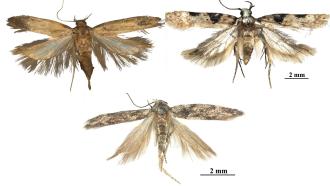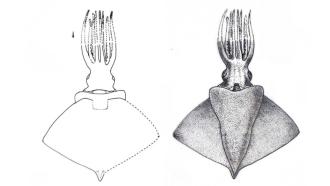
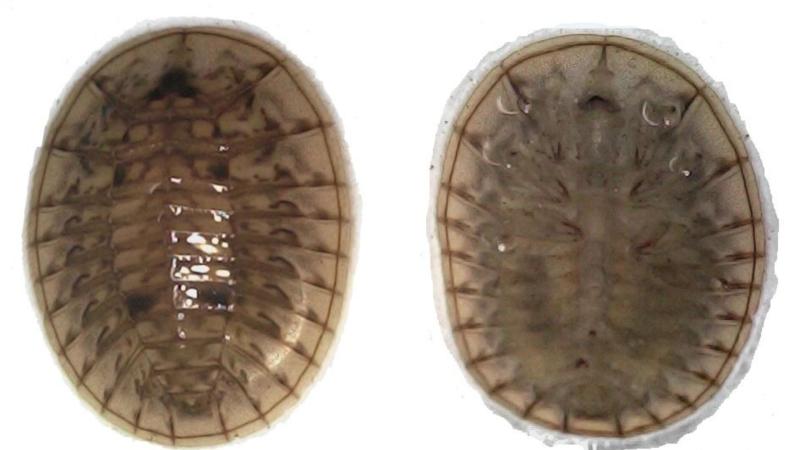
Jaechanax kuranganiensis larva. Credit authors - https://doi.org/10.55446/IJE.2025.3421
Researchers have uncovered a previously unknown species of the unique aquatic insect known as the water-penny beetle, marking the first-ever record of its genus in Tamil Nadu. The discovery, made in the fast-flowing Kurangani stream of the Bodi hills, introduces Jaechanax kuranganiensis to the world.
The research team from Government Arts College, Madurai, identified the new species by examining its distinctive larval form. Water-penny beetle larvae are famous for their flat, disc-like shape, which allows them to cling tightly to rocks in streams, resembling a tiny coin.
The species has been named kuranganiensis after the Kurangani stream where it was found. The main specimen, or holotype, is now deposited at the Government Arts College in Melur, Madurai, for future study.
The newly described species, J. kuranganiensis, is separated from its closest relatives by several key features on its larval body. Most notably, it possesses a unique groove, or oblique sulcus, on the shield-like segment behind its head (the pronotum). This groove forms a specific triangular structure that is not found in other species of the Jaechanax genus.
Furthermore, the researchers noted that the ninth and final abdominal segment of the larva is subrectangular and approximately 1.2 times wider than it is long, a crucial detail for distinguishing it from other known water-penny beetles.
This discovery marks the first time the entire genus Jaechanax has been recorded in Tamil Nadu, expanding the known range of this group of beetles. The genus was previously known only from three other species found in various Asian countries.
The larvae were collected manually from the submerged rocks, gravel, and pebbles in the Kurangani stream, a habitat influenced by both the south-west and north-east monsoons. At the time of sampling, the water was cool, ranging from 24 to 25°C, with a pH of 7.2.
Water-penny beetles play a vital role in the stream ecosystem, serving as an important part of the food chain. Researchers often use their presence and health as a bioindicator, a natural way to check the overall health and quality of the freshwater environment.
This article was written with the help of generative AI and edited by an editor at Research Matters.